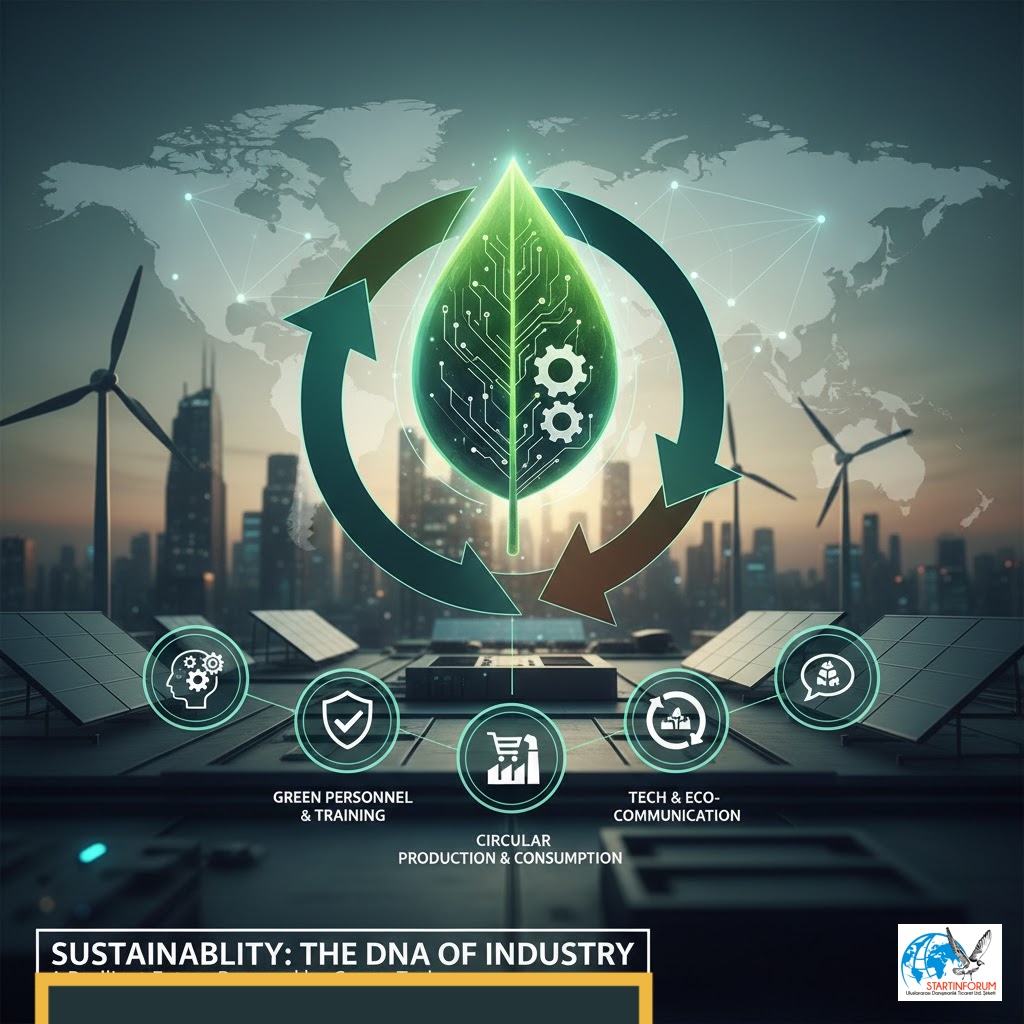
To truly elevate industry development, Sustainability must not be an “add-on” feature—it must be the DNA that binds all other milestones together.
A sustainable industry means a resilient industry.
Here is an extended focus on how sustainability acts as the core driver for modern industrial development:
The Sustainability Paradigm: The Fifth Milestone Of The International Business Development
The integration of sustainability transforms traditional industrial milestones from linear processes into circular, regenerative systems.
Sustainable Personnel Training: “Green Skills”
Professionalism in the modern era includes environmental literacy. Personnel training must now prioritize “Green Skills”—the knowledge and abilities needed to support a resource-efficient society.
-
- Eco-Innovation Training: Training engineers and technicians to design products with a “Cradle-to-Cradle” philosophy, ensuring every component can be returned to the technical or biological cycle.
-
- Environmental Diplomacy: Training leaders in international communication to navigate global climate accords (like the Paris Agreement or EU Green Deal) and represent their industry’s carbon-neutral commitments.
Quality and Compliance: The “Green” Gold Standard
Compliance is no longer just about safety or technical dimensions; it is about the Environmental Footprint.
-
-
- International Standards: Adherence to environmental and energy management standards is now a prerequisite for participating in international tenders, especially in the defense and manufacturing sectors.
- Lifecycle Assessment (LCA): Quality of work is now measured by the product’s entire life. Industries must prove that their production, from raw material extraction to end-of-life disposal, minimizes ecological harm.
-
Sustainable Production and Consumption: The Circular Economy
The milestone of national and international consumption is shifting from “mass consumption” to “responsible consumption.”
-
- Resource Decoupling: Developing the capacity to increase economic output while decreasing resource input. This involves using renewable energy and secondary raw materials.
-
- Sustainability as a Value Proposition: For international consumption, a product’s “Green Passport” (low carbon footprint, ethical sourcing) becomes its strongest marketing tool. Consumers, particularly in Europe and North America, are increasingly selecting products based on their impact on the planet.
Summary: The Sustainable Industry Framework
| Milestone | Sustainability Integration | Global Impact |
| Personnel Training | Focus on Green Skills & Ethics | Long-term workforce resilience. |
| Quality & Standards | Zero-waste & Carbon neutrality | Access to high-value “Green” markets. |
| Communication | Transparency & ESG Reporting | Enhanced investor and partner trust. |
| Consumption | Circularity & Durability | Reduced environmental load and waste. |
Strategic Conclusion
By focusing on sustainability, an industry ensures that its growth does not deplete the resources it depends on.
For STARTINFORUM, highlighting sustainability in university-industry collaborations ensures that the “Milestones” we develop are not just economically profitable, but globally respected and future-proof.
APBM 2026 - Sustainable Futures: Innovating For a Resilient World
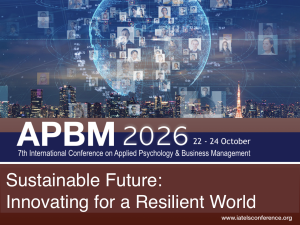 APBM 2026, 7th International Conference on Applied Psychology and Business Management, aims to unite researchers and practitioners from social sciences and business to discuss current trends and best practices with the focus on Sustainability and Resilience. We seek to raise awareness about advancements in international business, management, and psychology in a view of the current technological developments, AI, global economical and political processes.


Leave a Reply