Project Abstract
Artificial Intelligence is reshaping education, science, and society. With AI tools now widely accessible and playing a significant role in scientific and societal change, higher education faces the urgent challenge of preparing individuals – especially graduates entering the labour market – and institutions for this transformation.
Traditional models are no longer sufficient – AI-ready, innovative teaching strategies are essential. Yet universities must balance innovation with responsibility: integrating AI without compromising the human dimension of learning.
HUMAN-AI addresses this need by developing an ethical, human-centred model for AI use in higher education, both at institutional and individual levels. It proposes a soft skills framework tailored to academic contexts, aligns learning with labour market demands, supports curriculum innovation that combines digital literacy with ethics, human values, and responsible use, and assesses how higher education institutions respond to technological change while preserving the human element in teaching and learning.
The project also promotes policies that prioritise well-being, autonomy, and inclusive innovation.
Through activities targeting key stakeholders – students and practitioners – HUMAN-AI equips them to engage with AI safely and responsibly, without losing the relational aspects that define values-driven education. By organising public AI literacy events and conducting interactive school visits, the project enhances understanding and promote the responsible use of AI tools across society.
Aligned with EU priorities, HUMAN-AI supports ethical AI, inclusive lifelong learning, and value-driven digital transformation, contributing to Europe’s leadership in responsible education.
The consortium brings together experts from social and technical disciplines across EU and non-EU countries, including Poland, Estonia, Portugal, The Netherlands, Slovakia, Ukraine, Turkiye, Thailand, Kazakhstan and Brazil.
The Global Consortium
This project represents a powerhouse of academic and technical expertise, featuring 10 partners across the globe:
| No. | Partner Institution | Country | Role |
| 1 | Uniwersytet Śląski w Katowicach (US) | Poland | Coordinator |
| 2 | Tallinn University (TU) | Estonia | Partner |
| 3 | Universidade Aberta (UAb) | Portugal | Partner |
| 4 | Univerzita Konštantína Filozofa v Nitre (UKF) | Slovakia | Partner |
| 5 | Borys Grinchenko Kyiv Metropolitan University (BGKMU) | Ukraine | Partner |
| 6 | Helix5 (Helix5) | Netherlands | Partner |
| 7 | STARTINFORUM Uluslararasi Danismanlik (SF) | Turkiye | Partner |
| 8 | Kazakh State Women’s Teacher Training University (QyzPU) | Kazakhstan | Partner |
| 9 | Khon Kaen University (KKU) | Thailand | Partner |
| 10 | Universidade de São Paulo (USP) | Brazil | Partner |
Project Aims
The primary objective of the project is to develop an ethical, human-values-based model for the responsible, ethical and transparent use of artificial intelligence technologies in higher education, addressing both institutional and individual levels, and guided by a set of clearly defined, measurable, and achievable goals:
1) Propose an AI-ready soft skills framework tailored to the needs of higher education participants – increasingly vital for effective integration in AI-enhanced learning and professional environments.
2) Develop a robust methodology that aligns educational goals with the evolving demands of an AI-driven job market, while fostering human-centred skills.
3) Assess how higher education institutions are responding to technological advancements while maintaining the human element in the teaching and learning process.
4) Advance curriculum innovation that combines technological literacy with ethical awareness and meaningful teacher-student interaction.
5) Address AI-related education policies emphasising ethics, well-being, and human autonomy, while highlighting the importance of innovation guided by human values.
The Main Project Final Outputs
1) Methodological guidelines for AI-enhanced education – aimed at fostering learner-focused teaching practices;
2) Guidelines for ethical use of AI in higher education – contributing to the development of responsible, inclusive, and pedagogically sound technology integration strategies;
3) Modernised scalable curriculum implemented through 2 teaching modules – MA and MOOC – that will effectively address AI-related challenges;
4) Evidence-based policy recommendations for AI integration in higher education – promoting the establishment of transparent, and ethically responsible educational systems;
5) Peer-reviewed publications, including two academic monographs compilling the research findings – contributing to the academic discourse.
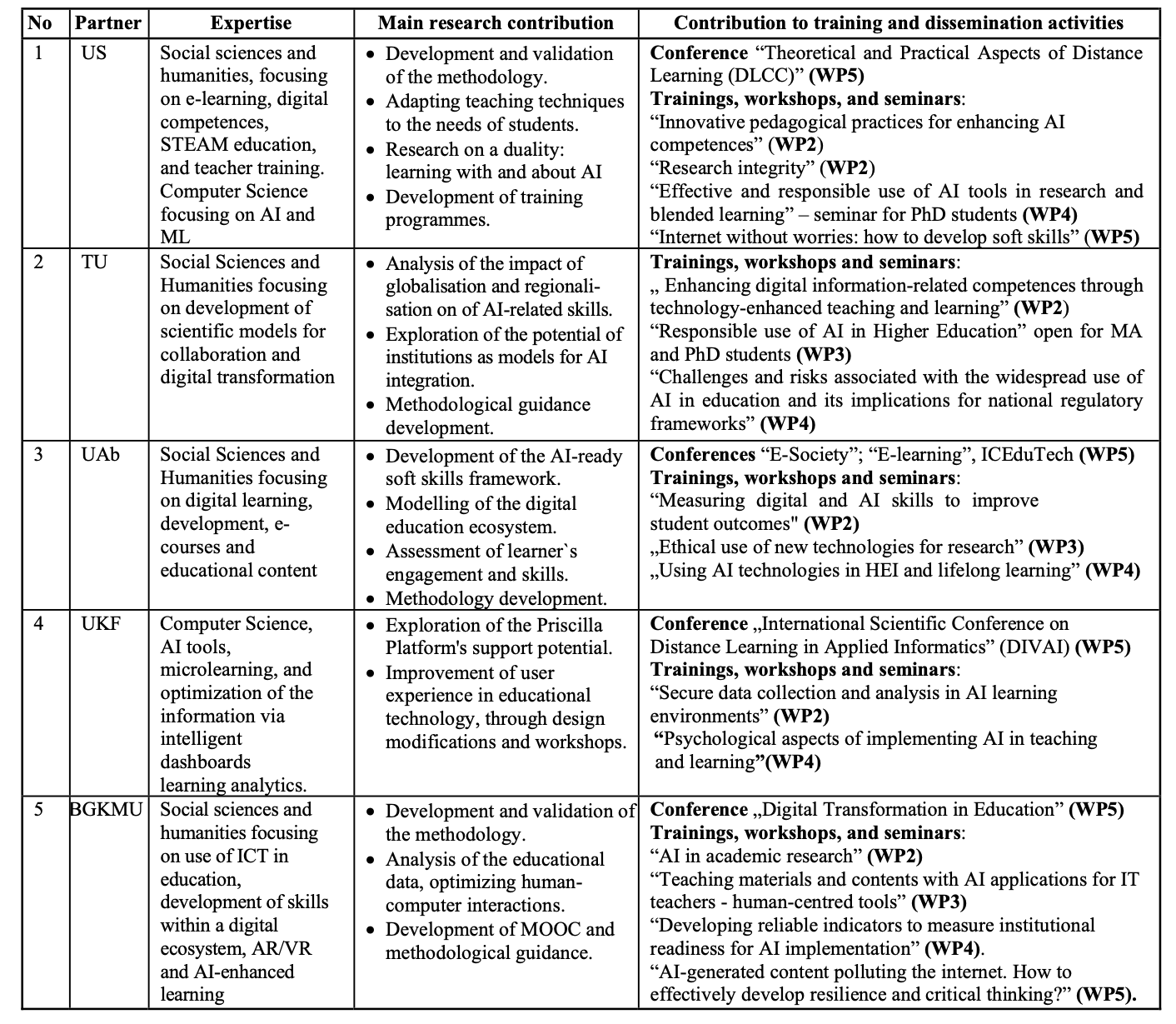
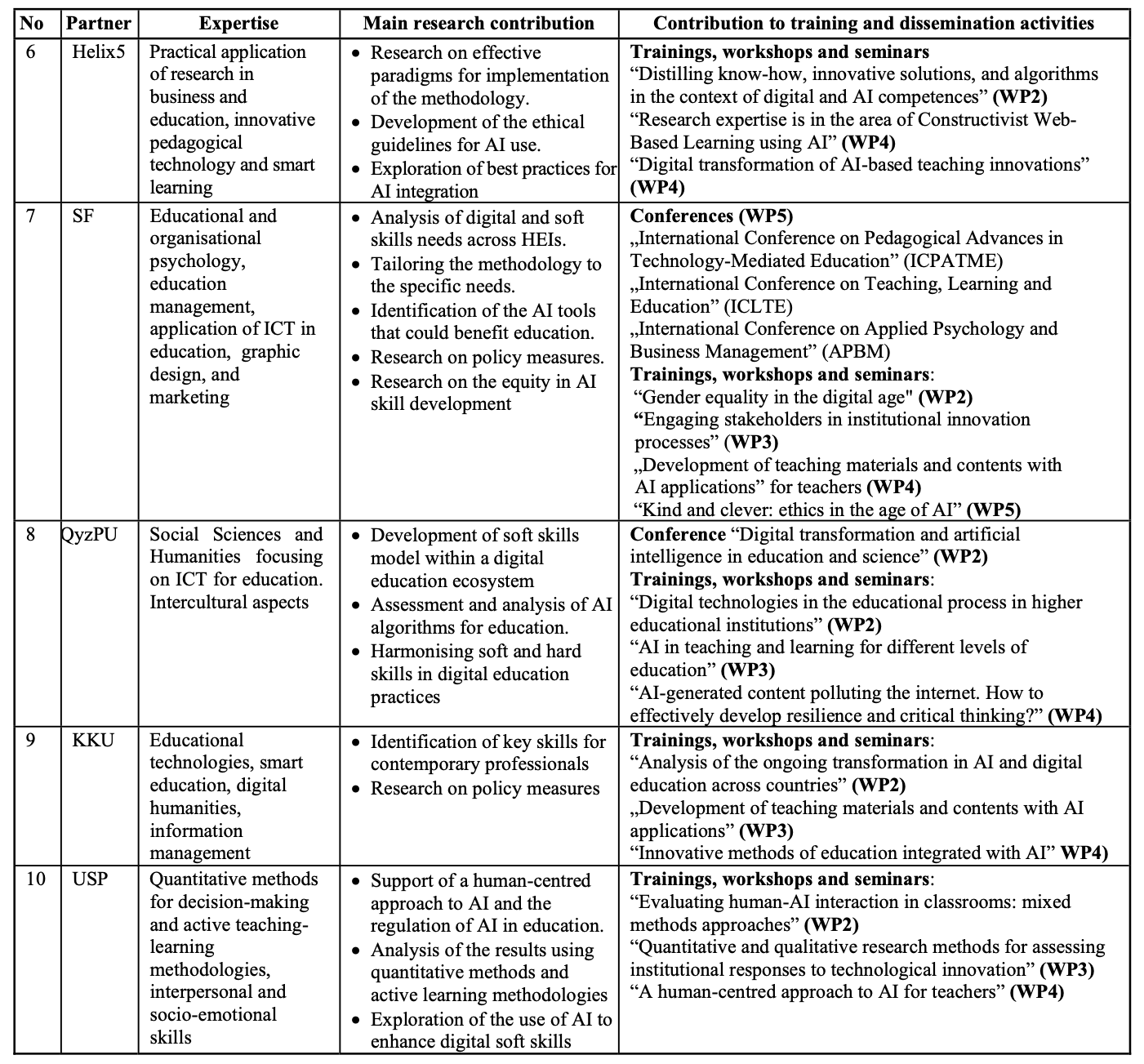
Contribution of Each Participating Organisation to the Project Planned Activities
Description of the Project’s Main Networking Activities
Working online meetings: platforms such as Zoom, MS Teams, X, Facebook, WhatsApp, and ResearchGate facilitate project activities. Zoom and MS Teams enable real-time meetings and collaboration, while WhatsApp ensures quick coordination. ResearchGate promotes academic networking and the sharing of results. These tools help establish a cohesive international team and support the project’s long-term sustainability.
Workshops, training sessions and seminars: The researchers acquire knowledge that will allow them to implement new research methods and work practices, and educate students in new, innovative ways. The estimated length of each training will be 1-2 days.
Stakeholder engagement events: will be organized to bring together consortium members, external experts, and relevant stakeholders to foster dialogue, share best practices, and identify opportunities for joint initiatives. This also includes participation in consultations, submission of position papers, and attendance of policy forums. Researchers will gain valuable experience in effectively presenting scientific findings to non-expert audiences.
Conferences: Conferences will support dissemination enabling the presentation of project findings to academic and professional audiences, facilitate direct feedback from stakeholders and foster knowledge exchange among participants and invited experts, thereby enhancing the visibility, relevance, and uptake of the project’s outcomes.
Collaborative research activities: data collection via class observations, longitudinal analyses, case studies, site visits, interviews, surveys, and data analysis, joint publications. Researchers will work across disciplines and cultures, improving professional and soft skills such as communication, teamwork, and ability to work in multicultural environments. This cooperation will provide them access to new resources and methods, enhancing research quality.
Fieldwork and study visits: gathering information about the environment in each project country enabling participants to gain practical experience and knowledge, with a particular focus on local customs, behaviors, ways of life, and work practices. This understanding will be crucial for conducting comparative analysis across countries.
Consultations: organised flexibly, based on needs and specific requests. This includes ongoing supervision of PhD students during their research activities, as well as assistance from the coordinator to partners on particular issues,
This will facilitate smooth collaboration and help address emerging challenges in a timely and effective manner.
Joint preparation of publications: we are planning to publish at least 10 joint scientific articles and 2 scientific monographs: “AI-Enhanced Education: Developing Skills and Adaptability for Human-Centred Education”, and “AI-Enhanced Education: Evidence-based Approaches and Methodological Guidelines”.
Meet Our Project Team
Core Expertise & Achievements:
Project Management: Coordination of international R&D projects in Education, Professional Development, ICT and e-learning, Organizational and Business Psychology.
Academic Leadership: Founder and sponsor of IATELS – International Association for Technology, Education and Language Studies, hosting three flagship annual conferences (ICET, ICLTE, APBM).
Digital Educational Innovation: Pioneer in AI-supported ELT and ESP Pedagogy through English IATELS.
Global Networking: Managing an extensive inter-sectoral network across Europe, Asia, and the Americas to foster professional mobility and innovative business-education partnerships.

Prof. Dr. Iryna Sekret is the founder of STARTINFORUM and IATELS Committee Chair. As an expert in Education and Psychology, she develops and coordinates international projects focusing on AI-driven pedagogy and digital competencies. With over 100 publications and extensive experience in FP7 and Horizon projects, she coordinates international R&D, develops innovatve methodologies and practical frameworks, manages global research dissemination via IATELS and publication projects.

Dr. Elif Öcalmış, PhD in Eastern Languages and Literatures, specializes in the intersection of philology and digital transformation. As a STARTINFORUM contributor to the HUMAN-AI project, she focuses on the ethical integration of AI in language teaching and literary translation. She is an expert in preserving the “human touch” and cultural nuance in the AI era. Her key contributions to the project embrace evaluating AI’s capacity to grasp psychological and socio-cultural ethics, leveraging her background in cultural diplomacy and South Asian academic networks to promote project findings internationally.

Andrii Sekret is an IT professional specializing in Software Engineering and Management. He leads projects in personnel management and development, LMS and educational platforms. Within the HUMAN-AI (HORIZON-MSCA-2025-SE) framework, he focuses on digital content development, website architecture, and AI-driven marketing strategies. His contribution centers on the technical integration of AI tools for education, streamlining LMS configurations, and enhancing virtual training environments.
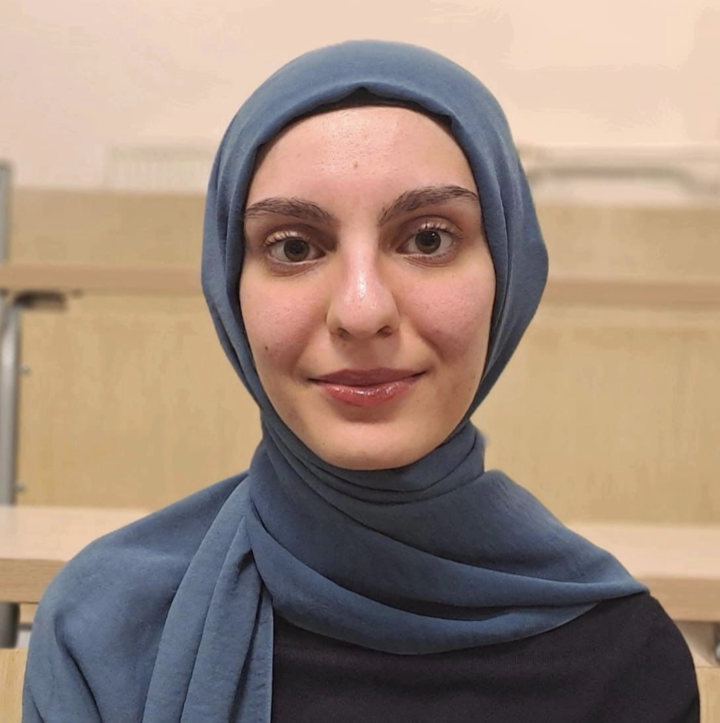
Zeynep Bülte is a soft-skill trainer, a member of the European Pharmaceutical Students’ Association (EPSA). She specializes in soft-skills development, delivers international training on leadership, teamwork, and communication. Within the HUMAN-AI (HORIZON-MSCA-2025-SE) framework, she focuses on AI ethics, and the impact of digital tools on student well-being. As a TEMA Foundation volunteer, she also integrates climate policy awareness into her advocacy for responsible technology.

Oleksii Sekret is a graphic design and arts specialist with extensive experience in educational event management and content development. In the HUMAN-AI (HORIZON-MSCA-2025-SE) project, he leads the analysis and testing of AI applications in multimedia and marketing. He is responsible for conducting needs assessments among university students and teachers, developing AI-driven graphic design methodologies, and delivering specialized training on related digital competencies.
Anchoring the Future of Digital Education in the Human Dimension
The official launch of the Horizon Europe HUMAN-AI project in November 2026 marks a transformative milestone in the global educational landscape. As artificial intelligence rapidly shifts from an auxiliary tool to a foundational pillar of modern pedagogy, the core mandate of this four-year academic consortium becomes undeniable: technological advancement must never come at the cost of human-centered values. Innovation is only as valuable as the psychological security, socio-emotional resilience, and structural equity it provides to the educators and learners navigating it.
Through its role in coordinating high-level European research and engineering groundbreaking digital solutions, STARTINFORUM, in partnership with the International Association for Technology, Education and Language Studies (IATELS), is uniquely positioned to bridge the gap between global policy and local execution.
By converting macro-level research into tangible assets, this initiative ensures that cutting-edge AI breakthroughs are seamlessly transferred directly into the classroom ecosystem.
Ultimately, the HUMAN-AI project is more than a research endeavor; it is a collaborative blueprint for a more inclusive, intuitive, and balanced future.
By empowering national institutions, equipping educators with modern competencies, and fiercely protecting the student’s psychological comfort, we are not simply preparing schools to adapt to an AI-driven economy. We are actively co-creating a sustainable educational reality where advanced technology serves as a catalyst to unlock the ultimate, irreplaceable potential of the human mind.