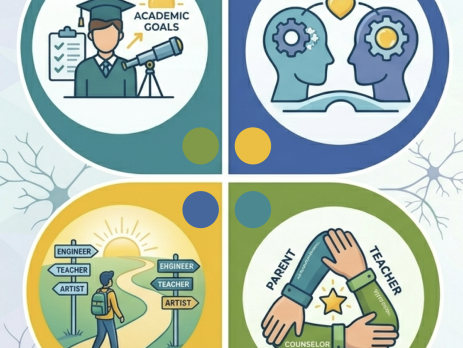
In school education, there is often a significant difference between the needed Duties of a School Counselor (what they are trained and hired to do) and the Reality of their daily work (what they actually spend their time doing).
If you are a School Counselor, School Administrator or a Parent, check the list to see if the psychological welbeing and sustainability are provided properly in your institution.
The School Counselor: Duties and Professional Responsibilities
Based on numerous study analysis and observations over the best practices, our team has highlighted the list of the primary responsibilities of the school counselor defined by educational psychology standards and school charters.
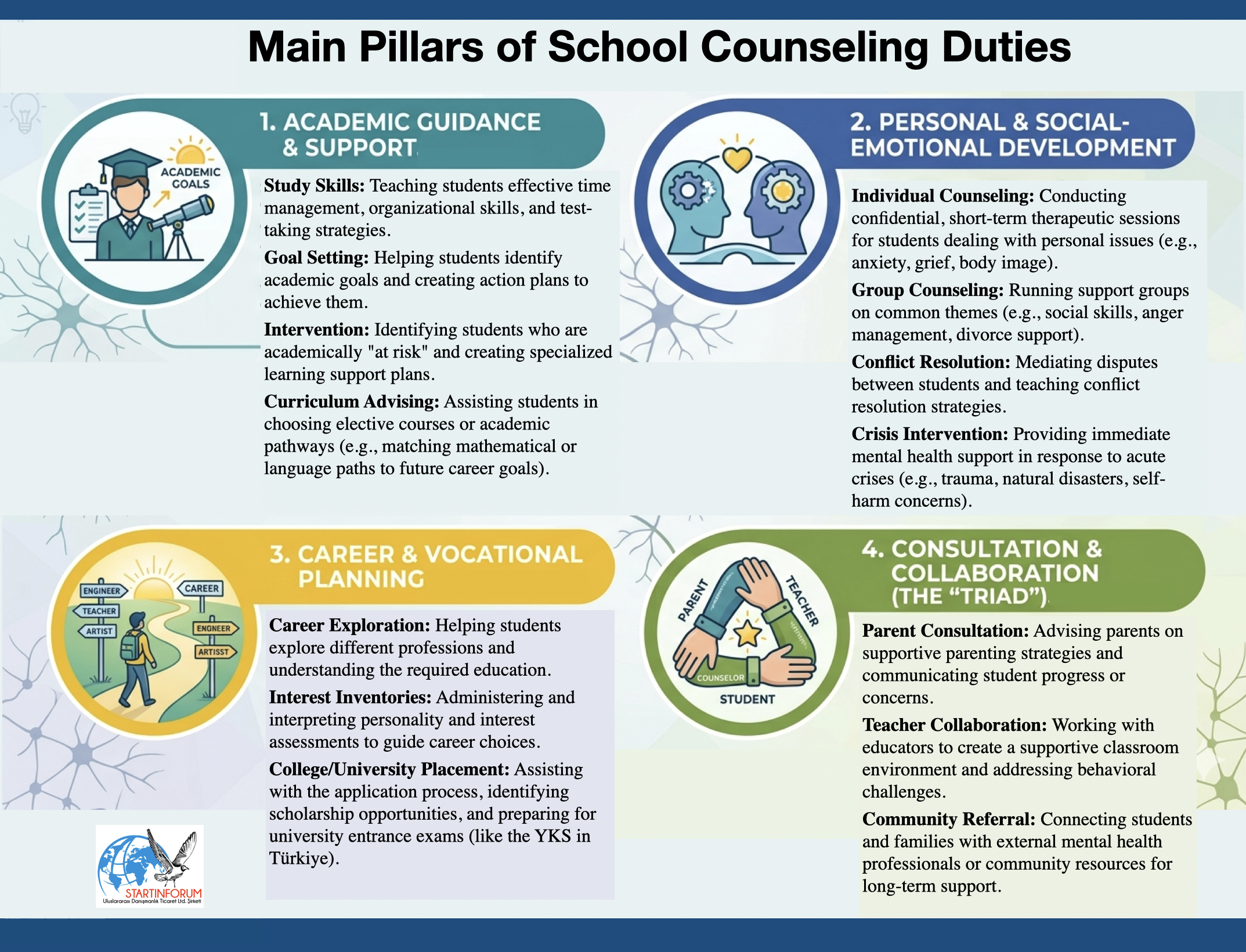
As a counselor’s goal is to support the holistic development of the student, their work must be organizsed around four mail pillars:
1. Academic Guidance & Support
-
Study Skills: Teaching students effective time management, organizational skills, and test-taking strategies.
-
Goal Setting: Helping students identify academic goals and creating action plans to achieve them.
-
Intervention: Identifying students who are academically “at risk” and creating specialized learning support plans.
-
Curriculum Advising: Assisting students in choosing elective courses or academic pathways (e.g., matching mathematical or language paths to future career goals).
2. Personal & Social-Emotional Development
-
Individual Counseling: Conducting confidential, short-term therapeutic sessions for students dealing with personal issues (e.g., anxiety, grief, body image).
-
Group Counseling: Running support groups on common themes (e.g., social skills, anger management, divorce support).
-
Conflict Resolution: Mediating disputes between students and teaching conflict resolution strategies.
-
Crisis Intervention: Providing immediate mental health support in response to acute crises (e.g., trauma, natural disasters, self-harm concerns).
3. Career & Vocational Planning
-
Career Exploration: Helping students explore different professions and understanding the required education.
-
Interest Inventories: Administering and interpreting personality and interest assessments to guide career choices.
-
College/University Placement: Assisting with the application process, identifying scholarship opportunities, and preparing for university entrance exams (like the YKS in Türkiye).
4. Consultation & Collaboration (The “Triad”)
-
Parent Consultation: Advising parents on supportive parenting strategies and communicating student progress or concerns.
-
Teacher Collaboration: Working with educators to create a supportive classroom environment and addressing behavioral challenges.
-
Community Referral: Connecting students and families with external mental health professionals or community resources for long-term support.
The School Counselor Reality – What Actually Happens
In modern school education, there is a fundamental and often critical disconnect between the idealized, developmental role a school counselor is trained for and the overwhelming administrative and reactive reality they experience daily.
This list delineates the systemic barriers and “non-guidance” activities that systematically consume a counselor’s specialized time, directly preventing them from performing their core duties effectively and ethically.
The Administrative Trap (Non-Guidance Tasks)
Perhaps the most significant drain on specialized resources is the “Administrative Trap,” which assigns counselors duties better suited to clerical staff or administrators. This trap manifests in three primary ways:
-
Clerical Paperwork: Counselors are often forced to act as data entry clerks, spending hours maintaining voluminous student files, writing mandatory reports, and tracking daily attendance rather than using that time to meet students.
-
Exam Coordination: A particularly illogical assignment is forcing the counselor to organize and proctor standardized tests. This removes them from their supportive role precisely when students need it most: during the stressful examination period.
-
Scheduling & Database Errors: Schools frequently misappropriate the beginning of the academic year by assigning counselors to manage class schedules, process endless course changes, and fix database errors, which directly consumes weeks of potential student-counselor meeting time.
Systemic Overwhelm (High Ratios)
This dimension highlights the mathematical impossibility of effective, proactive guidance due to overwhelming student numbers:
-
High Student-to-Counselor Ratio: In many public schools a single counselor may be responsible for over 500 students. This extreme ratio means individual support is mathematically impossible and proactive outreach is replaced by a desperate, broad-stroke approach.
-
The Reactive, Crisis-Only Model: Consequently, the counselor operates in a perpetual state of “crisis management”—or “putting out fires”—responding only to the most severe student emergencies (e.g., severe self-harm, extreme grief, violence) rather than implementing preventative, structured guidance programs for the entire student body.
Discipline & Supervision Misalignment
School administrators frequently fail to understand the counselor’s unique pedagogical role, assigning them tasks that directly contradict the ethical safe-space requirement of the counseling relationship:
-
Counselor as Disciplinarian: By asking the counselor to handle student discipline or deliver punishments, administrators fundamentally damage the counselor’s essential status as a “safe, neutral, and trusted adult,” causing students to avoid seeking help.
-
Hall/Lunch Duties: Standard supervisory duties (e.g., hallways, lunchrooms, bus loading) further reduce the counselor’s specialized time and reinforce their image as just another authoritatian supervisor, blurring the necessary boundary between guidance and administration.
Role Confusion & Stigma
This dynamic describes how systemic misuse and misunderstanding erode student trust in the guidance department:
-
“The Stigma Office”: When counseling is conflated with discipline, the counselor’s office becomes “The Stigma Office.” Students avoid visiting it, fearing they will be labeled as “being in trouble” or “having mental health problems” (rather than seeking proactive support for wellness and growth).
-
Teacher Misunderstanding: Some educators, lacking training in counseling ethics, view the counselor’s office as a “holding cell” or a simple solution for difficult behavior. They may send any “difficult student” to the counselor to remove them from the classroom, regardless of whether the issue is a mental health crisis, a simple behavior dispute, or just normal student restlessness.
The Gap in Diagnostics
Finally, even if a counselor somehow finds time for Category 2 (Social-Emotional) duties, they are frequently unequipped for the modern, complex environment:
-
Lack of Specialized Resources: Critical diagnostic tools are almost universally missing in the reality of the daily school environment. Counselors operate without modern psychological tests, risk assessment tools, or digital monitoring systems (such as those needed to track digital radicalization or severe anxiety markers), leaving them dependent solely on subjective interviews and observational data in highly complex situations.

An Invitation to Critical Dialogue: Addressing the Reality of Modern School Counseling
In contemporary school education, a profound and systemic disconnect exists between the Idealized Duties a school counselor is meticulously trained for and the overwhelming Daily Reality of their work.
This divide is particularly critical, where the developmental guidance model frequently clashes with traditional administrative demands and unsustainably high student ratios. The result is systemic counselor burnout, fragmented student care, and diminished institutional effectiveness.
We cannot address this challenge in isolation. It requires an honest, multi-stakeholder diagnostic and a committed, proactive training response.
Below, we detail the core dimensions of this “Reality,” inviting Administrators, Educators, and Counselors to engage in a shared analysis of their own context.
Part 1: The Diagnostic—Identify the Obstacles in Your School
We invite you to review these four dimensions of the counseling reality. Where do these challenges manifest most urgently in your institution?
The Administrative Trap (Non-Guidance Tasks)
Check List
-
Are your counselors spending hours manually maintaining extensive student files, writing repetitive reports, or tracking daily attendance?
-
Are counselors burdened with organizing and proctoring standardized tests?
-
Is the start of your academic year consumed by assigning counselors to manage class schedules and fix database errors?
-
Is your school operating under a ratio that makes individual or proactive group work impossible?
-
Is your counseling department forced to operate in a perpetual state of “crisis management,” responding only to severe emergencies, rather than implementing preventative, structured wellness programs?
-
Are administrators asking counselors to handle student discipline or deliver punishments?
-
Are counselors being assigned supervisory duties (hallways, lunchrooms, bus loading)?
-
Do school counselors apply specialized tools of modern psychological diagnostics, validated risk assessment tools, and digital wellness monitoring systems?
Part 2: The Call to Action—Dialogue and Training
The primary function of this diagnostic is to define the necessary training responses. Recognizing this reality must be the catalyst for professionalization and structural reform.
STARTINFORUM invites school leaders and counselor associations to collaborate on targeted capacity-building and strategic pilot initiatives:
-
Administrators & Leadership Training: Specialized workshops on “School Management for Counselor Effectiveness” and “Ethical Leadership in Guidance.”
-
Counselor Capacity Building: Intensive certifications in “Efficiency and Brief Intervention Techniques for High-Ratio Schools” and “Digital Wellness and Specialized Modern Diagnostics.”
-
Whole-School Dialogue: Facilitated workshops to redefine the counseling role at the institutional level, creating a clear local policy that protects the counselor’s specialized duties.
We must move beyond acknowledging the problem. We invite you to join us in diagnosing the gap and training the future of school counseling, ensuring that our counselors are architects of holistic success, not just administrators of a strained system.


Leave a Reply