
Foreign business investment in Türkiye is highly strategic due to aggressive investment tax reforms, competitive operational costs, and an official Foreign Direct Investment (FDI) Strategy (2024–2028) that prioritizes green and digital transformations.
To maximize capital efficiency and leverage state incentives, foreign entities should target these five high-growth sectors:
Export-Oriented Advanced Manufacturing
Türkiye is replacing traditional low-cost assembly models with advanced, high-value manufacturing hub operations.
-
Aggressive Tax Cuts: Under the April 2026 tax reforms, the Turkish government slashed corporate tax rates from 25% down to 9% for manufacturer-exporters.
-
Automotive & EV Supply Chains: As the 13th largest global automotive manufacturer, Türkiye exports over $41 billion annually. Foreign firms investing in electrical components, battery cells, and machinery gain tariff-free access to the European Union via the EU-Türkiye Customs Union.
-
Chemicals & Raw Materials: To bridge a severe domestic raw material trade deficit, chemical plants constructed within organized Industrial Zones (OSBs) trigger full VAT exemptions, customs duty waivers, and property tax relief.
Real-World Example
A European auto-parts manufacturer establishing a production facility in Bursa or Kocaeli pays a 9% corporate tax rate instead of 25% on export revenues, while sourcing specialized local labor at 30–40% lower costs than Central Europe.
Technology, Fintech and E-Commerce Enablement
Türkiye’s tech ecosystem attracts significant venture capital and international investment.
-
0% Corporate Tax on Software Exports: The 2026 structural transformation roadmap grants a 100% corporate tax exemption on income generated from exported services, including SaaS, AI development, and digital gaming.
-
Technopark Tax Shields: Locating inside an official Technology Development Zone (Technopark) waives corporate income tax, exempts R&D staff wages from personal income tax, and removes VAT on software sales.
-
Cross-Border E-Commerce Infrastructure: Setting up a Limited Company (Limited Şirket) enables foreign logistics and marketplace enablement firms to claim 50% tax deductions on overseas marketing and fulfillment expenses.
Real-World Example
An AI SaaS company setting up operations in ITU ARI Teknokent (Istanbul) or METU Technopolis (Ankara) pays 0% corporate tax on international software licenses while receiving up to 50% social security premium subsidies for its local engineering team.
Renewable Energy and Clean Technology
To curb its reliance on imported energy, Türkiye has liberalized its power grid and created massive financing pipelines backed by international bodies like the World Bank.
-
High-Yield Infrastructure: Prime opportunities exist in utility-scale solar farms in Central Anatolia, wind power along the Aegean coast, and geothermal generation.
-
Feed-in Tariffs & Grid Priorities: Clean energy projects benefit from guaranteed long-term feed-in tariffs (YEKDEM) denominated in local currency with inflation adjustments, alongside prioritized grid connection rights.
Real-World Example
An international clean-tech fund co-investing in a 50 MW solar installation in Konya qualifies for Zone 5/6 regional incentives, which include state-backed interest subsidies on bank loans and a 10-year employer social security contribution waiver.
Health Tourism and Specialized Hospitality
The fusion of healthcare and hospitality represents one of Türkiye’s fastest-growing export services.
-
Medical & Wellness Hubs: Private equity firms are targeting specialized dental centers, hair restoration clinics, aesthetic surgery hospitals, and thermal wellness resorts.
-
Inflation-Shielded Service Exports: Medical tourism operators qualify for the 100% service-export corporate tax exemption. Because earnings are predominantly foreign-currency denominated (EUR/USD/GBP), operators gain a structural hedge against local currency fluctuations.
Real-World Example
A foreign healthcare group acquiring a specialized clinic in Istanbul collects revenues in Euros from European patients while covering local operational costs in Turkish Lira, shielding net profits through service-export tax exemptions.
Agritech and Advanced Food Processing
As Europe’s largest agricultural producer, Türkiye offers high raw material volumes but lacks localized high-tech processing capacity.
-
High-Growth Segments: Core targets include automated greenhouse technology, climate-resilient seed production, organic processing lines, and cold-chain logistics networks.
-
Strategic Geographic Reach: Processed goods packaged in Türkiye hit major European, Middle Eastern, and North African retail markets within 48 to 72 hours via overland and maritime freight.
Real-World Example
A foreign agritech entity establishing automated hydroponic greenhouses in İzmir or Antalya leverages agricultural investment subsidies—receiving up to 50% capital grant matches for energy-efficient equipment purchases.
Strategic Entry Guide for Foreign Entities
Establishing a foreign business presence in Türkiye requires selecting the optimal legal vehicle:
| Company Structure | Min. Capital Requirement | Setup Timeline | Best Suited For |
| Limited Liability Company (LLC / Limited Şirket) | 50,000 TRY | 5–10 Business Days | Tech startups, mid-sized exporters, service agencies, e-commerce firms |
| Joint Stock Company (JSC / Anonim Şirket) | 250,000 TRY | 10–15 Business Days | Large industrial setups, energy projects, regulated financial entities |
| Liaison Office (Irtibat Bürosu) | None (no commercial activity) | 3–6 Weeks | Market research, non-revenue promotional hubs, feasibility studies |
How STARTINFORUM Empowers Foreign Business in Türkiye
Navigating Türkiye’s evolving regulatory landscape, structural tax reforms, and multi-sectoral incentives requires more than just market summaries—it demands operational execution and localized expertise. STARTINFORUM serves as a strategic project management and business consultancy partner, helping foreign entities translate Turkish market trends into actionable growth strategies.
1. Decoding Local Business Trends and Market Opportunities
While global macroeconomic shifts create fast-moving dynamics in Türkiye, STARTINFORUM bridges the intelligence gap by providing deep, sector-specific market analysis:
-
Real-Time Tax and Incentive Intelligence: StartinForum actively monitors and maps localized incentive structures—such as the 9% manufacturer-exporter corporate tax rate, 100% service-export tax exemptions, and regional Organized Industrial Zone (OSB) benefits—ensuring foreign capital targets high-yielding projects.
-
Sector-Specific Feasibility Analysis: Whether evaluating Technopark alignment for tech startups or assessing supply chain networks for automotive and chemical manufacturing, STARTINFORUM conducts thorough data analyses to validate product-market fit before capital commitment.
3. End-to-End Execution and Local Representation
Under Law No. 4875, foreign investors hold the right to 100% foreign ownership without requiring local partners. STARTINFORUM provides the operational and legal backing necessary to act with complete confidence:
-
Flexible Remote or On-Site Setup: StartinForum assists foreign founders in establishing entities either remotely via Apostilled Power of Attorney (PoA) or through an accelerated 3–5 day in-person incorporation workflow.
-
B2B Matchmaking & Institutional Support: Beyond setup, STARTINFORUM acts as an operational anchor—representing foreign business interests, facilitating local supplier partnerships, and providing continuous guidance on Turkish trade regulations and export frameworks.
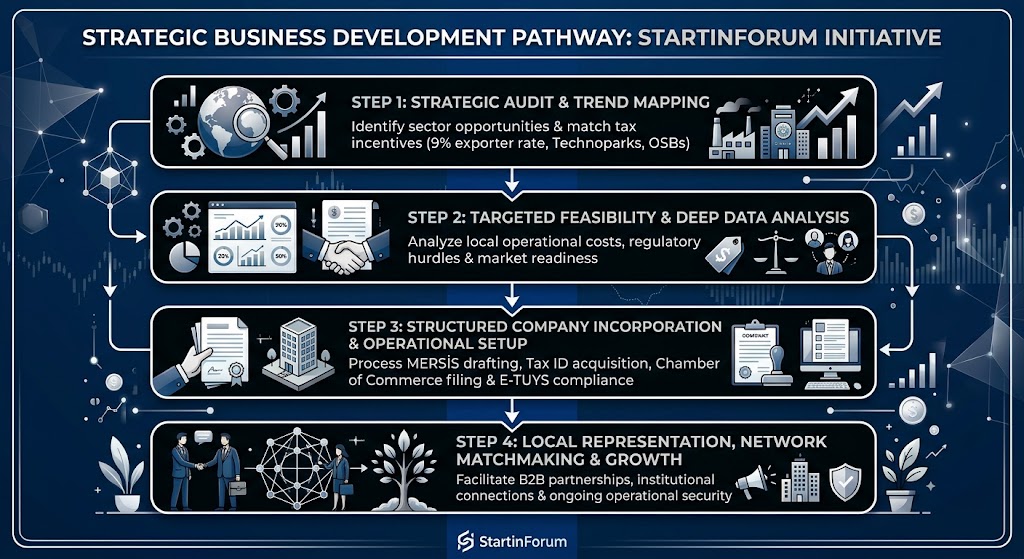
2. A 4-Step Operational Engagement Framework
STARTINFORUM utilizes a structured, 4-step consultation and execution methodology designed to eliminate bureaucratic delays and streamline foreign market entry:
Initial Consultation and Problem Mapping
Deep Analysis and Strategic Business Plan
Execution and Company Incorporation
Evaluation, Reporting and Expansion
Ready to Build Your Türkiye Entry Strategy?
Take the first step toward launching your business or expanding operations in Türkiye:
-
Schedule a Consultative Strategy Session: Discuss your investment vision directly with STARTINFORUM’s management team.
-
Request a Sector Feasibility Study: Evaluate tailored tax savings, Technopark incentives, and operational setup timelines for your specific industry.
-
Direct Enquiries: Contact the StartinForum team at info@startinforum.com or call +90 536 859 1232.


Leave a Reply