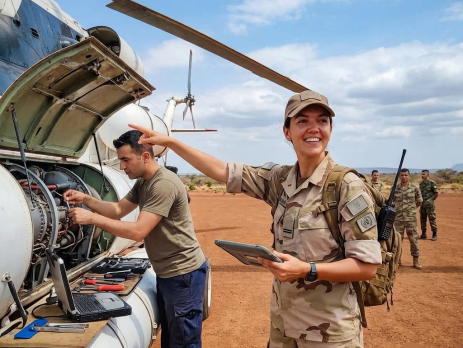
The breakneck speed of modern military technology is almost exclusively measured by highly visible hardware milestones: the extended range of a new ballistic missile, the autonomous swarm capabilities of next-generation unmanned aerial vehicles, or the seamless physical mating of smart precision munitions onto tactical airframes.
Millions of dollars and years of rigorous engineering are poured into perfecting the mechanical and digital tolerances of these machines.
Yet, when these systems deploy in active operational theaters, their actual tactical efficacy relies entirely on a much more volatile variable: the human component tasked with operating, maintaining, and integrating them.
One of the most critical, yet frequently underestimated, priorities in the contemporary defense ecosystem is scaling the cognitive, psychological, and operational communication capacities of engineering teams and field personnel at the exact same pace as the physical hardware.
When these human-centric workflows are treated as secondary considerations or dismissed as soft skills, significant structural bottlenecks emerge during joint deployments and international co-development projects.
Without proper structural support, these hidden operational friction points leave advanced systems and high-stress missions highly fragile at the exact moment they need to be resilient.
Critical Gaps in Modern Defense Workflows
Human-Machine Interaction (HMI) Under Active Stress
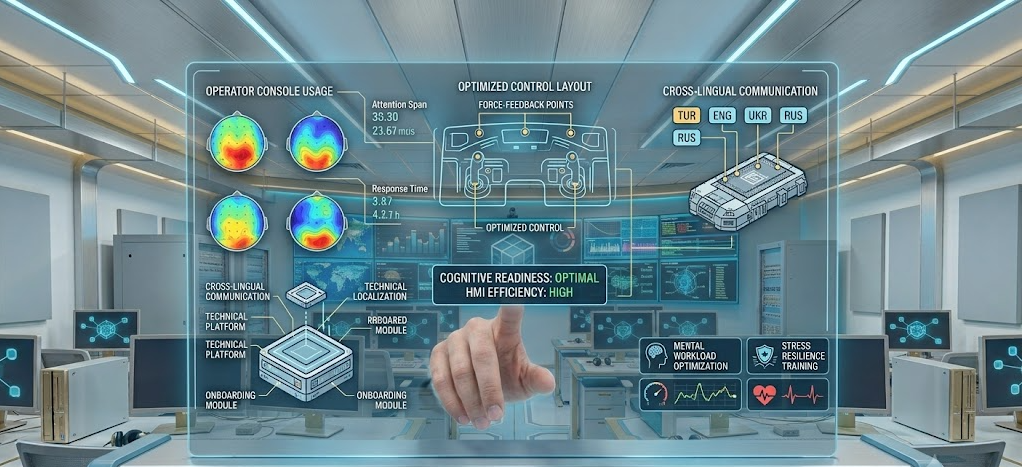
Operators stationed inside modern Ground Control Stations (GCS) or command-and-control centers do not just operate machinery; they manage an intense, ceaseless vortex of data streams, radar feeds, sensor telemetry, and automated target-acquisition algorithms, all while working under acute, life-or-death time pressures.
When these control interfaces are designed without rigorous integration of cognitive ergonomics, the human brain becomes rapidly overloaded.
This systemic overload manifests directly as severe mental fatigue, which drastically slows down reaction times, degrades situational awareness, and introduces catastrophic margins for error in identification and target validation.
If a multi-million dollar weapons system features an interface or an onboarding methodology that fails to align with the principles of organizational psychology and human cognitive limits, the technology ceases to be an asset and becomes an operational liability.
Cross-Border Language Pairs and Technical Friction
The modern defense industrial base is no longer siloed within national borders; it is fundamentally international, built upon a web of cross-border alliances and complex technology transfers.
When defense primes collaborate to integrate highly specialized precision-guided munitions onto foreign tactical unmanned platforms, it requires engineering teams from entirely different linguistic and institutional backgrounds to co-develop code, troubleshoot telemetry links, and draft shared deployment protocols.
When this highly technical collaboration relies on broken, ad-hoc translation pipelines or general-purpose interpreters, critical engineering nuances are lost, resulting in severe administrative delays, software mismatches, and physical integration errors.
Successfully managing and streamlining technical communication across distinct linguistic frameworks—especially in complex, direct cross-pairs—is currently a persistent logistical and operational headache for international defense contractors.
Organizational Behavior Under Extreme Pressure
Maintaining a rigid, uncompromising military hierarchy while simultaneously fostering the high-level cognitive agility required to adapt to rapidly fluid, asymmetric threats is one of the most difficult balancing acts an organization can face.
Defense-adjacent enterprises, specialized engineering units, and remote operator crews are regularly subjected to prolonged operational stress, yet they rarely possess structured, data-driven frameworks to monitor and analyze their own personnel’s internal endurance.
Without actionable research into organizational behavior and stress dynamics, teams operating under continuous high-pressure environments begin to exhibit unseen fractures in communication, leadership fatigue, and systemic burnout, which can silently compromise an entire operation from the inside out.
How STARTINFORUM Coordinates Capacities for the Sector
Recognizing that conventional corporate training programs and rigid academic structures completely fail to address the highly specific, high-stakes requirements of the modern defense sector, STARTINFORUM actively coordinates its extensive institutional and educational network—including its deep management of IATELS—to deliver targeted, non-hardware support directly to our partners within the defense industrial complex.
By bridging specialized global academic research with industrial agility, we have constructed a operational framework designed to transform theoretical human-factor principles into concrete tactical advantages:
Digital Onboarding & Tailored Training Modules
We take complex technical blueprints, highly dense payload flight manuals, and intricate software telemetry guidelines and strip away the instructional noise. Our platform develops customized online training modules specifically engineered for targeted technical learning needs and rapid deployment. This allows international integration teams, technical staff, and field operators to master specialized platform configurations in a fraction of the traditional training timeline, significantly reducing deployment lag and drastically lowering the rate of human instructional error during initial system rollouts.
Multilingual Technical Communication Hubs
Leveraging our deep linguistic infrastructure, we provide professional technical translation, rigorous localization, and tailored communication frameworks customized specifically across complex cross-pairs of English, Ukrainian, Russian, and Turkish.
We work directly with engineering units and cross-border procurement teams to ensure that all parties are perfectly aligned on identical technical nomenclature, safety protocols, and software compliance terms, completely eliminating the operational friction caused by linguistic ambiguity during international system integrations.
Applied Psychology & Human Factors
We channel specialized scientific and behavioral research directly into actionable, field-ready data for defense enterprises.
Our initiatives focus on conducting comprehensive psychological research in Human-Machine Interaction, organizational behavior, and personnel management while working in and under high-stress conditions.
By evaluating the layout and usability of telemetry interfaces and developing custom behavioral strategies, we actively safeguard operator endurance under continuous operational pressure.
The Strategic Outlook: What Needs to Be Done
To prevent human capability from lagging behind increasingly automated and autonomous hardware, the international defense sector must actively prioritize several definitive strategic shifts in how it manages its human capital:
Transition from Static Documentation to Dynamic Learning: The era of thick, printed, unchangeable technical manuals must come to an end. Defense enterprises must transition toward agile, cloud-based micro-learning ecosystems that can be updated instantly across global networks the moment a new software patch is deployed or a hardware modification is made in the factory.
Integrating Cognitive Metrics in Simulators: Tactical simulator training must evolve past the basic assessment of whether an operator can press buttons in the correct sequence. Simulators need to integrate biometric tracking—such as continuous heart-rate variability monitoring and advanced eye-tracking—to map cognitive load in real time, actively teaching personnel how to recognize and manage their own physiological responses to stress.
Cross-Border Communication Protocols: For joint international manufacturing ventures and co-development programs, standardized cross-cultural crisis management models and unified technical communication workflows must be treated as mandatory corporate compliance procedures. They must be integrated into the core contract framework from day one, rather than being treated as an afterthought when communication issues arise.
Ultimately, no matter how autonomous, intelligent, or self-sufficient military hardware becomes, the definitive node in design, systems integration, and strategic command remains the human being.
Through its targeted coordination pipelines, STARTINFORUM provides strategic partners with the precise educational, linguistic, and psychological infrastructure required to keep that human node sharp, secure, and operationally resilient under any conditions.



Leave a Reply